

If your service team or your Agentforce agents answer questions from SharePoint pages, Google Drive files or a public help site, there is a good chance that content reaches Salesforce through Unified Knowledge. The Unified Knowledge retirement is now fixed: Salesforce has moved the end date to June 2027 (Summer '27 release) and states in its official retirement notice that there will be no further extensions. Seven months sounds comfortable, but a migration that touches licensing, Data 360 credits, prompt templates and agent testing rarely fits into the last sprint before a release. This article explains what is changing, who is affected and a practical plan to get ready.
What the Unified Knowledge retirement changes
Unified Knowledge was announced in May 2024, built with Zoomin, to bring third-party content such as SharePoint, Confluence, Google Drive and company websites into Salesforce alongside Knowledge articles (Salesforce newsroom). It was mainly used to ground Agentforce answers and to power customer-facing knowledge.
Here is the timeline published by Salesforce:
- April 2026: strict maintenance mode. No new customers, no new sales or renewals, no new features; only critical issues are fixed.
- May 2026 to June 2027: the same restrictions apply, and migration to the replacement path is possible.
- June 2027: Unified Knowledge is no longer available or supported, and the connector infrastructure is decommissioned.
Two details matter for planning. Knowledge articles created through Unified Knowledge stay in place after the retirement, but the sync from external sources stops. And when you finally delete a Unified Knowledge source, its articles and attachments are permanently lost, so the clean-up step must come after your new setup is validated.
Who is affected (and who is not)
Check your org against these profiles:
- Affected, high priority: orgs where an Agentforce agent or a prompt template is grounded on content ingested by Unified Knowledge. Answers will stop being refreshed and then lose their source.
- Affected, medium priority: service teams and Experience Cloud sites whose search or help experience relies on external content synced by Unified Knowledge.
- Affected, budget owners: whoever owns the Salesforce contract. The recommended replacement runs on Data 360 and may consume credits.
- Not affected: orgs that only use native Lightning Knowledge articles written in Salesforce. You can keep working as today.
If you are not sure, open Setup and search for Unified Knowledge. Any configured source means you have work to do. This is the same type of review we recommend for other retirements on the calendar, such as the Salesforce for Outlook retirement or the Open CTI retirement.
The replacement: Enterprise Knowledge on Data 360
Salesforce points customers to Enterprise Knowledge, powered by Data 360. According to the Trailhead Enterprise Knowledge module, it combines native Salesforce Knowledge with external content such as wikis, policy documents and runbooks in one searchable base. External systems remain the source of truth, Data 360 keeps an indexed copy in sync, and existing permissions control who sees what. It is read-only and complements Lightning Knowledge rather than replacing it.
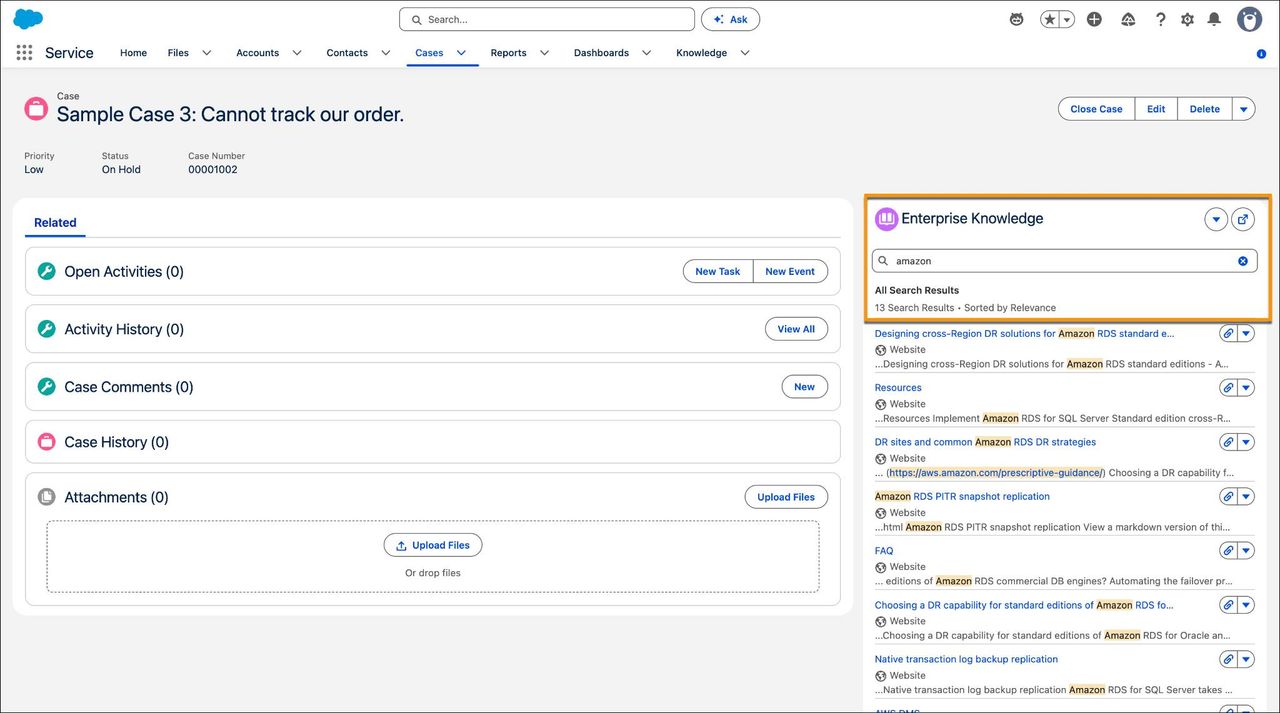
As of April 2026, the Data 360 unstructured connectors listed by Salesforce are Google Drive (Beta), SharePoint (Beta), Web Content (Crawler), Web Content (Sitemap) and Zendesk (Beta). Note what is missing: if you ingested Confluence or another source through Unified Knowledge, confirm the path for it with your account team before you plan anything else.
Before committing, weigh the trade-offs honestly:
- Choose the Data 360 path if your agents must answer from SharePoint, Google Drive or web content, and you can absorb the licensing and credit impact.
- Consider moving content into Lightning Knowledge if the external content is small, stable and better owned by your service team in Salesforce.
- Consider retiring the source if usage data shows nobody, human or agent, actually relies on it.
The migration guide also notes that the unstructured connectors currently serve Agentforce grounding. If your main need is search for human agents or a customer portal, validate that scenario first.
Step-by-step migration plan
This sequence follows the official guide and adds the governance steps we see missing in most projects:
- Inventory your sources. List every Unified Knowledge source, its volume, its owner and which agents, prompt templates or sites consume it.
- Check licensing and credits. Confirm Data 360 provisioning with your Account Executive and review the Data 360 billable usage types so ingestion and search costs are budgeted.
- Create the connection in a sandbox. Set up the unstructured data connection and its Unstructured Data Lake Object (UDLO). In the mapping, enable semantic search with system defaults to create the search index and retriever.
- Update prompt templates. In Prompt Builder, replace the old retriever with the new Data 360 retriever, set the search text to the right input, and save as a new template so you keep a rollback option.
- Update the agent. Clone the agent version in Agentforce Builder, swap the old prompt template action for the new one in each relevant topic, and keep the instructions identical.
- Test against real questions. Use Conversation Preview with a list of 20 to 50 frequent customer questions. Compare old and new answers before activating.
- Activate, monitor, then delete. Activate the new version, monitor for a few weeks, and only then delete the Unified Knowledge source.

Do not forget the people side. Service agents and knowledge owners need to know where content now lives, who maintains it and how to report a wrong answer. A short session per team is usually enough.
What to do this month
A retirement in June 2027 still deserves action before the end of 2026. Here is a short checklist:
- Confirm whether Unified Knowledge is configured in production and in each sandbox.
- Name one owner for the migration, ideally the person who owns your knowledge base, not only the admin.
- Ask your account team for Data 360 licensing and credit estimates in writing.
- Book sandbox time early in 2027, ahead of the Summer '27 preview window, and add the test cycle to your release update plan.
- Write the list of reference questions that will decide whether the new setup is good enough.

The goal is simple: on the day the old connectors are switched off, your customers and agents should not notice anything except, ideally, better answers.
Conclusion
The Unified Knowledge retirement is not a technical detail. It touches what your agents say to customers, what you pay in Data 360 credits and how your knowledge is governed. Start with the inventory and the licensing question now, test in a sandbox in early 2027, and keep the deletion step for last. If you want help scoping the move, our Salesforce Service Cloud team can review your knowledge setup, and our Salesforce Data Cloud services cover the Data 360 connectors and search configuration, including Agentforce grounding tests.